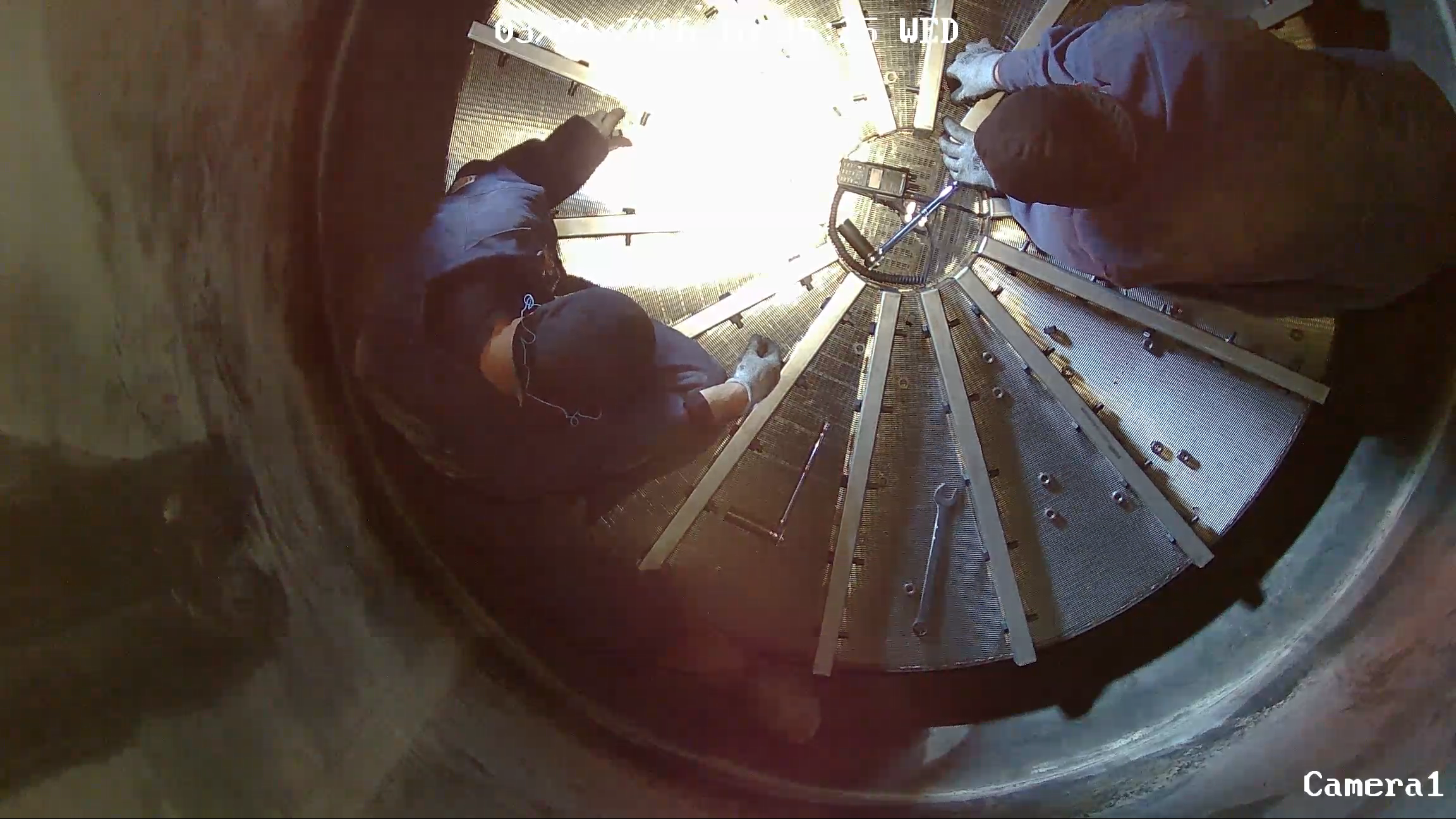
Installation of a WMP OSG.
By Russell Hillenburg, President & CEO, Woven Metal Products
Reactors are foundational to production in many process industries, yet many plants continue to rely on legacy reactor outlet support systems with ongoing operational challenges.
In axial flow reactors, traditional outlets, or elephant stools as they are sometimes called, often result in excessive pressure drop, uneven flow distribution, catalyst or media containment issues, along with a heightened risk of fouling or blockage. Installation and retrofit work frequently require welding to the vessel shell, extending outages and increasing cost and complexity during maintenance and repairs.
As operators face mounting pressure to increase throughput, reduce energy use, and maintain reliable operations, these issues have become increasingly problematic. Historically, available solutions focused on incremental design changes or replacements rather than addressing the root causes of poor performance.
That’s why the team at Woven Metal Products (WMP) sought to create a better answer for outlets in axial reactors.
Working alongside global licensor Topsoe, WMP spent years in research and development to create and patent a new solution: the WMP Outlet Support Grid (OSG).
WMP considered mechanical, fabrication, and installation constraints and realities when developing its OSG.
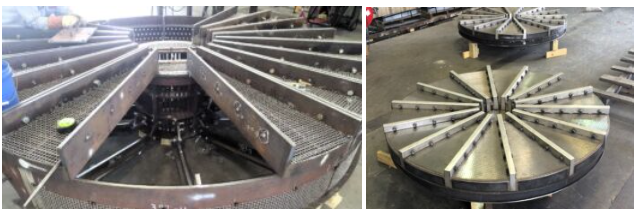
Each WMP OSG is customized for the intended vessel.
Its unique design minimizes the pressure drop at the reactor outlet system — by as much as 75% compared to conventional support grids or standard outlet designs. This reduction delivers immediate operational benefits, including a higher production capacity with lower energy consumption.
The performance gains extend beyond pressure drop alone. The OSG’s optimized design enables the support grid to be positioned lower in the base of the vessel than traditional installations. This design change increases the usable catalyst or media volume within the reactor by up to 40% in some applications. For units where catalyst inventory is a primary driver of performance, the additional capacity directly improves reactor effectiveness and supports higher production rates without requiring vessel modifications.
Ease of installation and long-term maintainability were also integral to the redesign.
Each OSG is custom engineered for the specific reactor and is designed for installation through the existing manway, also eliminating the need for welding to the vessel shell. The overall fabrication window is also short, sometimes as little as six weeks.
As a result, pressure vessel authority approvals are typically not required, simplifying project planning and reducing outage scope. The WMP OSG design often eliminates the need for packing rope or insulation and can be readily retrofitted into existing vessels. Installation is commonly completed in less than 24 hours per reactor, and the WMP OSG can be removed in sections to facilitate inspection or repair during future turnarounds.
From a turnaround standpoint, the WMP OSG typically requires less support material than traditional designs. This reduction lowers costs and minimizes the labor and downtime associated with reactor unloading and reloading. For end-users, these combined benefits have resulted in payback periods measured in months rather than years.
If your reactor performance is being impacted by high pressure drop, energy inefficiency, or capacity limitations tied to legacy outlet designs, the WMP OSG offers a proven, engineered solution. It’s one of several patented solutions WMP has developed to address real customer issues.
To learn more about how this technology can be applied to your reactor system, contact Woven Metal Products at 281-331-4466, info@wovenmetal.com or wovenmetal.com/contact.