
By Robert Lasser, VP Business Development / Tower Division
Decades of design evolution shape every turnaround decision about mass transfer internals. It comes into play whether you’re ordering a replacement-in-kind product or choosing an upgraded option. Most engineering teams and turnaround managers rarely think twice about that history.
However, understanding the background explains why certain designs get specified for revamps. It also explains why a newer-generation tray or packing can sometimes add capacity to an existing column, without a bigger tower or a new unit.
How Trays Evolved
Trays have evolved over time, with sieve trays being used first as simple perforated plates in early industrial columns, while bubble-cap trays were invented and patented later. The bubble-cap improved design added a riser and a slotted cap over each hole to maintain a liquid seal and prevent liquid from leaking (“weeping”) at low vapor rates and was used extensively in the 1920s.
By the early 1950s, the modern moving/floating valve tray had become the standard for distillation in the chemical industry. Later, fixed valve trays, with valve elements punched directly out of the metal deck, offered higher reliability, excellent fouling resistance, lower manufacturing costs, and no risk of loose parts traveling downstream.
Each generation of tray design allowed for higher capacity without demanding a larger column. Each iteration solved the same core tradeoffs: surface area, capacity and pressure drop. The geometry just got more refined.
That progress didn’t happen in isolation. It tracked advances in metallurgy, manufacturing tolerances and fabrication technique. The result was more flow in the same physical space, so operators could debottleneck aging columns rather than replace them.
However, newer doesn’t always mean better. Some mass transfer processes require a long mixing residence time while on the tray. In that case, a bubble-cap tray may work best, as it can give liquid and vapor the longest residence time due to infinite turndown capability. If your reaction depends on that mixing time, a modern tray won’t serve you as well. Bottom line: the process should drive the tray choice.
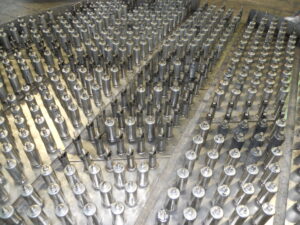
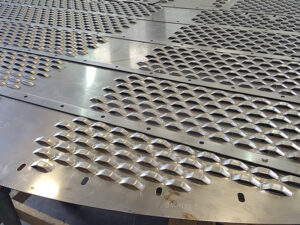
A bubble cap tray (left) and a fixed valve tray (right)
How Packing Evolved
As refiners raised process rates, their trays began to flood, and many turned to packing as the solution. First came random packing with simple cylindrical rings. Later came rings with slotted and more open walls that let vapor and liquid move through more freely. Those were followed by metal saddle designs and further refined high-efficiency shapes. Next came structured packing, often presented and heavily marketed as the “next-gen” solution.
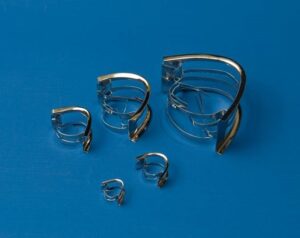

Generic random packing saddle rings (left); Structured packing (right)
Today, several original equipment manufacturers (OEMs) sell patented geometries for both random and structured packing. Many OEMs patent these unique shapes to capture market share, so these newer options deserve close attention.
When you install a newly patented geometry, other suppliers may not offer an equivalent for a decade or more. Your tower is then locked into a packing available from only one supplier, which lessens your flexibility when it’s time for replacements.
What This Means for Your Next Turnaround

History becomes practical and helpful when the quote for replacement lands on your desk. Here’s what we recommend.
- Move to structured packing only when you need to. While it offers top efficiency and capacity, it also wears faster. In our experience, structured packing is made from thinner materials, and it gets replaced about twice as often as more robust random packing. For most basic services, random packing can work well, and for longer.
- Weigh lock-in before you sign. Patented structured packing from one OEM is custom made for your tower at the time of order. Down the road, this means that you can’t utilize multiple suppliers for discovery damage, and your lead times for your custom replacement may adversely impact your overall outage. Out-of-patent packings are easier to source during outages because multiple suppliers can provide them, which matters when the volume needed is more than a single source can deliver. Our team stocks random packings in different sizes and alloys and can supply them in an emergency.
- Use price as only one part of the decision. Management of change (MOC) decisions for patented internal upgrades often only focus on one vendor’s limited offering, not your plant’s long-term ownership implications. Check the material thickness. Packing can be thinner than you expect, and in corrosive service that means shorter service life. Our post Buyer Beware: Know Your Quote walks through what to look for in a quote, especially with patented packings tied to a single vendor.
- Solve problem towers with data. Flooding, purity or efficiency issues call for the careful review of the best packing options for your process, not the newest patented one being highly marketed. Rely on third-party results, such as FRI.org test data, to compare how patented products perform vs. out-of-patent options.
The Takeaway
Every generation of trays and packing solved real problems. The right choice for your column still depends on your process, your emergency replacement strategy and your long-term ownership cost. History gives you the context to ask better questions before you buy, and make product decisions that not only perform well, but also keep your plant running beyond your next outage.
Our team at WMP can help you evaluate your options. Get in touch today: https://wovenmetal.com/contact/ or call +1 281-331-4466.